

For India I was traveling with my friend Emma, from Ireland, who I’d met in Vietnam many years previously. We decided to do a group tour since it would be easier to have someone else do all the organizing for us and all we had to worry about was being on the bus on time. Here is a map of our 15-day itinerary.

Delhi has always been an important part of India due to its location on the route between western & Central Asia and Southeast Asia. The area has been inhabitated for about 2500 years and Delhi has been the capital of India since 1911. The city prospered after becoming the capital, but that has also led to overcrowding, pollution, traffic congestion, and extreme contrasts between rich and poor.

Humayan’s Tomb at 50m/164ft tall was the first of the grand dynastic mausoleums that were to become synonyms of Mughal architecture. The architect Sayyid Muhammad Ghiyas chose to design arches of different sizes and repeated recesses to bring the building to human scale. Over 160 members of the Mughal family are buried in the lower cells.

Each window was intricately cut out like this.

This is how they make those windows with the cut out design. They start with a solid block and cut out the holes accordingly.

More images from Humayan’s Tomb

More images from Humayan’s Tomb

The walls of the Red Fort vary between 18m/60ft to 33m/108ft in height and extend for 2km/1.2miles.

The Red Fort was constructed by Shah Jahan between 1638 and 1648. He never got to use the fort since he was deposed and imprisoned by his son Aurangzeb. After Aurangzeb, the rulers were plagued by civil wars and the fort wasn’t maintained well. In 1857 the British cleared all but the most important buildings to make way for barracks and army offices. Since Indian Independence many landmark speeches have taken place at the fort including the Prime Minister’s address each year on Independence Day (August 15th).

Jama Masjid is India’s largest mosque and can hold over 25,000 people. This was Shah Jahan’s final architectural opus built between 1644 and 1658. Despite the sign that said, “No unaccompanied women” we climbed the 121 steps of the minarets that reach 40m/131ft high to get a great view of the city.

They gave us these fashionable outfits so that we are covered up properly.

View of the mosque courtyard as we were making our way up to the top of the minaret.

View of Delhi and the Red Fort from the top of the minaret.

View of Delhi from the top of the minaret.

View of Delhi and the Red Fort from the top of the minaret.

India Gate (42m/138ft) pays tribute to the 90,000 Indian Army soldiers who died in WWI, the Northwest Frontier operations, and the 1919 Anglo-Afghan War.

Lodi Gardens is Delhi’s loveliest park.

The Lotus Temple with its 27 petals is shaped like the sacred lotus flower. It was designed by Canadian-Iranian architect Fariburz Sahba in 1986.

Emma and I at the Lotus Temple

The Birla Temple was built in 1938 and was inaugurated by Gandhi as a temple for all castes. A sign on the gate states, “Everyone is welcome.”

The buildings of the Qutab Minar date back to the Islamic rule in India. Sultan Qutb-ud-din began its construction in 1193, immediately after the defeat of the last Hindu kingdom in Delhi. It’s nearly 73m/40ft high and it tapers from a 15m/49ft diameter base to a mere 2.5m/8ft at the top. The first three stories are made of red sandstone and the 4th and 5th stories are made of marble and sandstone. The tower stands outside a mosque which was the first one built in India.

The 7m/23ft iron pillar was made around AD400. There is an inscription stating that it was erected outside a Vishnu temple, but it does not state how the pillar was made. It is of exceptional purity and scientists can not figure out how the iron hasn’t rusted in the 1500+ years after being cast using the technology that was available at the time.

The Qutab Minar

The Qutab Minar

The Qutab Minar

Detail of one of the buildings at the Qutab Minar.

The Qutab Minar
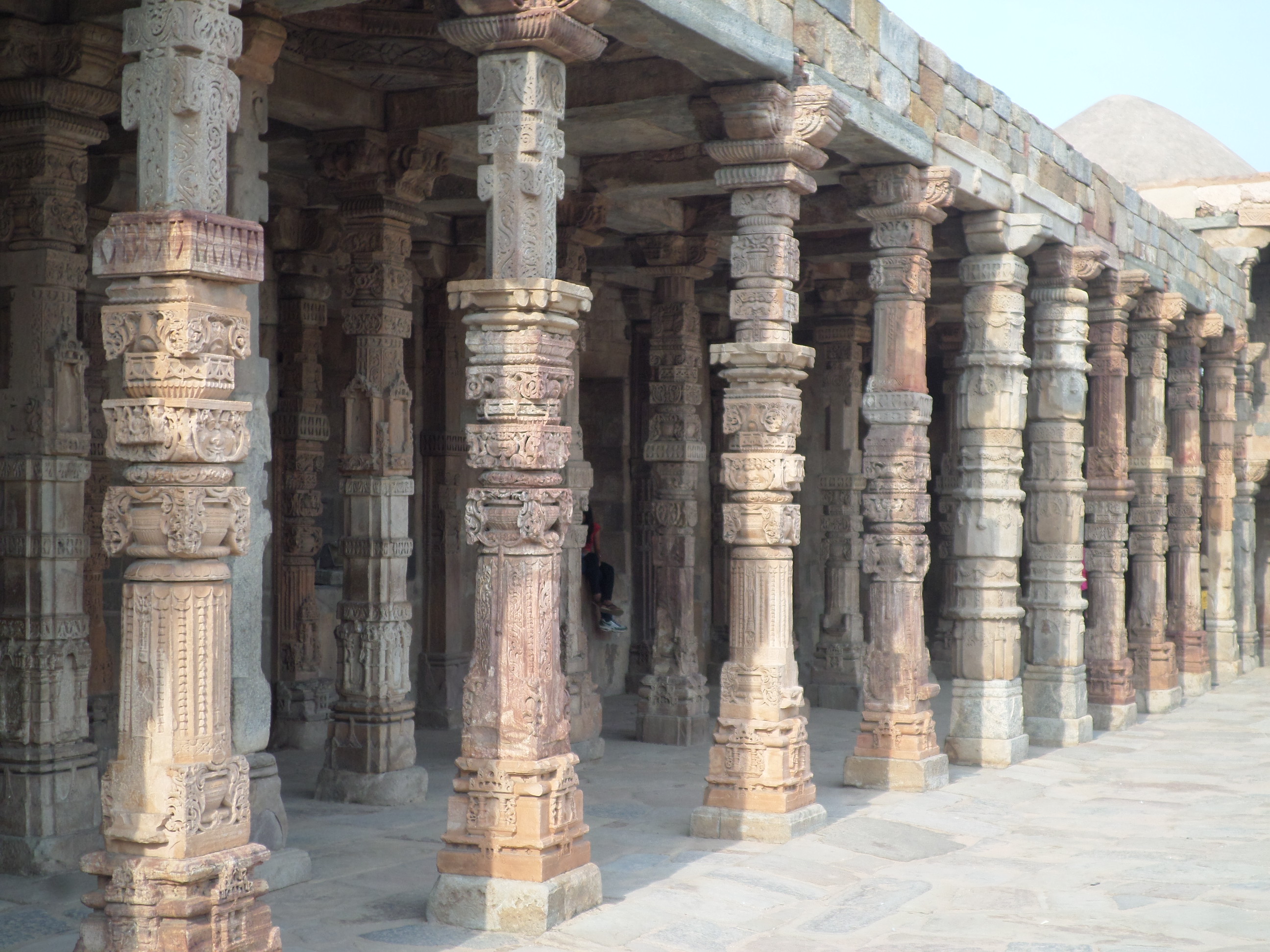
Amazingly etched pillars at the Qutab Minar.

Detail of one of the buildings at the Qutab Minar.

Gurdwara Bangla Sahib is the most prominent Sikh house of worship in Delhi.

As with all Sikh Gurdwaras, the concept of langar is practiced, and all people, regardless of race or religion may eat in the Gurdwara kitchen (langar hall). The Langar (food) is prepared by gursikhs who work there and also by volunteers who like to help out.

The Salaam Balaak Trust offers two hour “street walks” that are led by former street kids who show what life is like for inner-city homeless kids. The trust helps kids go to school and also offers a shelter for kids who can’t stay with their parents.

Emma has a friend in Delhi and she was nice enough to invite us over for dinner.

Her family was so kind!

Appetizers

Dinner

Dinner

Delhi

Delhi

An old school iron

Delhi

Delhi

Delhi

Delhi

The Akshardham Temple is a tribute to Bhagwan Swaminarayan (1781-1830), was built in only five years, and completed in 2005. It is 43m/141 ft high, 96m/316 ft wide and 109m/356 ft long. The exterior is colored sandstone while the interior is white marble. It contains about 20,000 carved figures and 234 intricately carved pillars.

Outside there are 148 carved elephants each with different postures and expressions.
Recent Comments